Chapter IV – Laura, Singapore & Melbourne
big world out there
This is the first big “hinge” moment. Travelling overseas for the first time.
If the 1970s were about being moved around by other people’s decisions, the mid-1980s were my first attempt at moving myself even if I still didn’t quite know where I was going.
Looking back, those years form a clear line. Port Augusta and Juvenile Justice; Adelaide and Anglican Child Care then Melbourne, Child Protection in Dandenong and adoption and permanent care in South Melbourne. At the time it just felt like hanging on and taking the next step when it appeared. I didn’t have a clear map, just a sense that staying still wasn’t the answer.
Laura
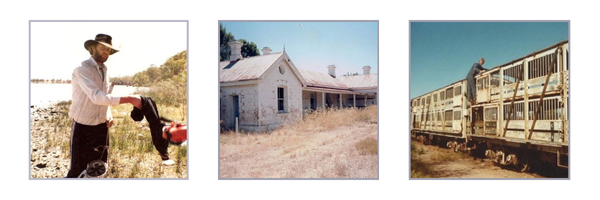
One of the more unlikely stops on that path was Laura, a small town in the mid-north of South Australia. For a while we lived in the Laura Railway Station itself, with the old narrow-gauge wheat trains still rattling past. The romance of it was undeniable narrow gauge grain trains a couple of times a day but to a young couple it felt like we were doing something faintly interesting with not much money.
Eventually we bought a house in the town. That move from station to house felt like a step towards the kind of normality other people seemed to manage automatically. Mortgage, community, routines, local sport. I doubled down on cricket, winning a few premierships and making some country representative sides. Weekends were for whites, sunburn, and the gentle satisfaction of seeing your name occasionally appear in the local paper’s sport section.
Welfare Roles
Work during this period pulled me deeper into the world of juvenile justice and youth work. It wasn’t glamorous, and it certainly wasn’t well-paid, but it made sense to me in a way school and factory work never had. I participated in a number of challenging Outward Bound–
style programs with young offenders taking them out bush, pushing physical and emotional limits, trying to show that the world was larger than the streets they knew.
Those programs were hard on everyone. But they were also instructive. You learn a lot about people when they’re cold, tired and carrying a pack up a hill they didn’t choose to climb.
Singapore
My first trip overseas was to Singapore, sometime in the early 1980s. For a boy from the bush, it was a big step.
Up to that point my world had mostly been small towns, country roads and the odd trip between cities, heat, long distances and places where most people either knew you or knew your family. Singapore was none of that.
The city felt busy, organised and dense. Everything seemed close together and vertical. The humidity was strangely familiar, but the rest of it wasn’t. The food didn’t taste like anything I’d grown up with. The smells, the sounds, the mix of languages being spoken around me. All of it was new. What struck me most was how modern it felt and how completely normal that was for the people who lived there. For them it was just home. For me it was a different way of living that I hadn’t really imagined before.
It didn’t turn me into a different person overnight, but it did shift something. Until then, my idea of “the world” came mostly from maps, TV and other people’s stories. In Singapore, the world became something you could walk around in, get lost in and queue up for food in.
Looking back, that trip became the second defining moment in my life. The first had already pushed me onto a slightly different track. Singapore showed me there was much more beyond the edges of what I knew and that I could actually go and see it. It made the idea of travelling, working and living in other places feel possible, not just something other people did.
At the time it was only a short trip and I probably treated it as a break from routine. In the longer run, it opened the door to the idea that I didn’t always have to stay put and that my not-quite-at-home way of being might make more sense on the move than in one fixed place.
couple more addresses
By the mid-1980s I was in Port Augusta, working in Juvenile Justice. It suited the pattern that had already started to form – regional towns, kids on the edge of things, systems that never quite had enough resources. The work was tough, sometimes rewarding, often frustrating. You dealt with the same families and the same names coming around in different combinations.
Port Augusta itself was a hard sort of place then. Railway town, highway town, crossroads for people going somewhere else. I learnt a lot there, mostly by getting things wrong first. It was another step along the way, but after a while the pull of something different grew stronger. The city started to beckon.
By 1987 I was back in Adelaide, though “back” makes it sound more settled than it was. I was looking for a change but still had no clear sense of direction. I lived in a few places short term, shifting around as opportunities or cheap rent came up. That was fairly standard for me then – enough stability to keep going, not enough to feel anchored.
Work-wise, I spent some time with Anglican Child Care. It kept me in the same general world – children, families, people under pressure – but from a slightly different angle. Different office, different language, same kind of problems underneath. I was still working things out as I went. There was no grand career plan, just a string of decisions that seemed reasonable at the time.
Around then, the idea of moving interstate started to get louder. There were a few distant incentives – personal, professional, and just a general itch that I couldn’t scratch by staying put. I’d already done plenty of moves between towns, but this felt bigger. At some point you either keep talking about it or you bite the bullet. I chose the latter.
In 1988 I made the move to Melbourne. It was a big step, leaving familiar people and places for something I only half-understood. I’d lived there briefly before, but this time it was different. This wasn’t passing through – this was a reset.
I ended up working in Child Protection in Dandenong. That was an eye-opener in its own right. Dandenong in the late 80s wasn’t a quiet outer suburb. It was busy, stretched, and constantly dealing with the fallout of poverty, migration, family breakdown, and all the usual things that push people to the edges. The pace was faster, the caseloads heavier, and the work more complex than anything I’d dealt with in the smaller towns.
From there I shifted into adoption and permanent care work in South Melbourne. Same broad field – children, safety, families – but with a different focus and a longer horizon. Instead of dealing mostly with immediate crises, there was more work around long-term planning, matching, and trying to give kids some kind of stable future after a lot of disruption. It was still messy, still imperfect, but it had a different rhythm.
Looking back, those years form a clear line: Port Augusta and Juvenile Justice; Adelaide and Anglican Child Care; then Melbourne, Child Protection in Dandenong, and adoption and permanent care in South Melbourne. At the time, it just felt like hanging on and taking the next step when it appeared. I didn’t have a clear map, just a sense that staying still wasn’t the answer.
The move interstate turned out to be one of those decisions that only really makes sense in hindsight. It pulled together the threads of what I’d already been doing – kids, families, remote and regional work, then city-based services – and pushed me into roles that would shape a lot of what came later. At the time, it was just 1988, another year, another move. But it quietly shifted the trajectory.